Outdoor winterizing takes more than a valve shutoff or a quick cover, and three common myths leave the plumbing services at commercial properties exposed to frozen exterior lines and unplanned downtime every winter.
A cracked exterior line at a place of business rarely stays a small problem, since commercial property freeze damage during operating hours can shut down a location for a full day or longer, costing real revenue.
Fall in the Shenandoah Valley can shift from mild afternoons to a hard overnight freeze within a single week, which is exactly why commercial outdoor plumbing so often gets overlooked until real damage finally appears at the worst possible time.
Key Takeaways
- Shutting off the main valve alone leaves standing water in exterior lines, which still freezes and cracks
- Commercial irrigation winterizing requires compressed air, not a simple shutoff at the control valve
- Insulation covers protect only exposed fixtures, not the pipe running through walls or below ground
- A burst exterior line during business hours often means a full closure, not just a repair bill
- Insurance Information Institute data shows water damage and freezing cause over a quarter of property claims
- K. Jenkins Plumbing winterizes commercial properties across 36-plus Virginia and West Virginia service areas
Myth 1: Shutting Off the Main Valve Protects the Property
Shutting off the main exterior valve at a commercial property is enough to prevent freeze damage. It stops new water from entering the line, but it does nothing about water already sitting inside the pipe.
Standing water left inside an exterior commercial line still freezes and expands exactly the same way, whether the valve upstream is open or closed. Multi-building property plumbing services often cover several exterior valves.
A cracked line from this myth often is not found until a wall cavity or ceiling tile in a leased Virginia unit shows visible water damage, long after the freeze event, so business property plumbing needs a full inspection, not a glance at the valve.
- The pipe section between the valve and the fixture still holds water after the valve closes
- Ice expansion inside that trapped section can crack a line even with every valve shut off
- Multi-tenant buildings often have several separate exterior lines that each need individual draining
- A commercial plumbing inspection finds trapped water a valve shutoff alone always misses
Myth 2: Are Insulation Covers Enough for Exterior Pipe?
An insulated cover on an exterior spigot or hose connection looks like a complete winterizing fix, and that assumption costs commercial property owners the most money of any myth these plumbing services see all winter.
Commercial water line freeze protection:
The practice of draining and insulating an exterior line along its full length, not just covering the visible fixture where the pipe exits the building wall.
A cover only insulates the exposed fixture. It does nothing for the pipe running through an exterior wall, a mechanical room, or an unheated utility space in a Virginia building, which is usually where the real freeze damage begins.
Real exterior spigot freeze protection means insulating the pipe for its full length inside the wall or mechanical room, not just wrapping the visible spigot where it exits the building each fall season.
| Relying on Insulation Covers Alone This Winter? Our licensed plumbers handle complete commercial water line freeze protection, including full line drainage and insulation, backed by upfront pricing, no hidden fees, and satisfaction and workmanship guarantee. |
According to Insurance Information Institute claims data, water damage and freezing caused a loss in 1.6 percent of insured homes over the five-year period from 2018 through 2022, one of the most common perils under a typical policy.
A frozen exterior line at a business often leaks inside a wall cavity long before staff notice standing water pooling on the floor near the fixture. That average claim covers far more than one fixture replacement.
- A cover protects only the exposed fixture, not the pipe running behind the wall
- Buildings with lines routed through an unheated utility space need more than surface insulation
- Exterior commercial plumbing needs full-length insulation, not just coverage at the connection point
- A commercial pipe inspection service checks the full line, not just the visible connection point
Read More About: Copper Repiping: Signs Your Virginia Home Needs It Now
Myth 3: Do Outdoor Irrigation Lines Winterize on Their Own?
Commercial irrigation winterizing is the myth business owners get wrong most often, since many assume a larger system with more zones simply empties itself once the growing season officially ends each fall.
Backflow preventer winterization:
Clearing water from a property’s backflow prevention device and underground irrigation lines using compressed air, since gravity alone cannot remove water trapped in low points.
A commercial irrigation system’s underground lines at a Virginia property hold water in low points and bends across every zone. Left untreated, that trapped water freezes, expands, and cracks fittings buried below the property.
- A backflow preventer sitting above ground is especially vulnerable to a hard winter freeze without service
- Larger commercial systems have far more zones, which means more low points that trap standing water
- A cracked irrigation line often is not found until the system runs again in spring
| Never Had Your Irrigation and Backflow Setup Professionally Winterized? Jenkins Plumbing clears irrigation lines and backflow preventers with compressed air before the first hard freeze, with same-day availability across Virginia and West Virginia service areas each fall. |
According to EPA WaterSense outdoor water use data, outdoor water use accounts for more than 30 percent of total water use at many properties, much of it running through the same lines that need winterizing every fall.
A poorly winterized irrigation system risks a spring repair bill on top of wasted water, and skipping the service simply invites commercial water line freeze damage in one more place across the property.
Why Do These Shortcuts Keep Failing Commercial Properties?
Each of these three myths shares the same root problem: a partial fix that looks complete on the surface but leaves standing water somewhere, waiting for the first hard freeze to find it, no matter how reliable the plumbing services otherwise are.
A valve shutoff, an insulation cover, and an untouched irrigation system at a Virginia property all address one visible symptom instead of the full line. Properties relying on them still end up calling for emergency plumbing service every winter
| Shortcut | What It Actually Covers | What It Misses |
| Main valve shutoff | Stops new water from entering the line | Water already trapped inside the pipe |
| Insulation cover | Insulates the exposed fixture only | The pipe running through the wall or utility space |
| No irrigation service | Nothing, the system is left untouched | Water trapped in underground low points and bends |
A full winterizing visit addresses every point above at once, which is why business plumbing maintenance plans should always include a commercial plumbing winterization visit each fall before the first hard freeze.
How K. Jenkins Plumbing Winterizes Commercial Property Right
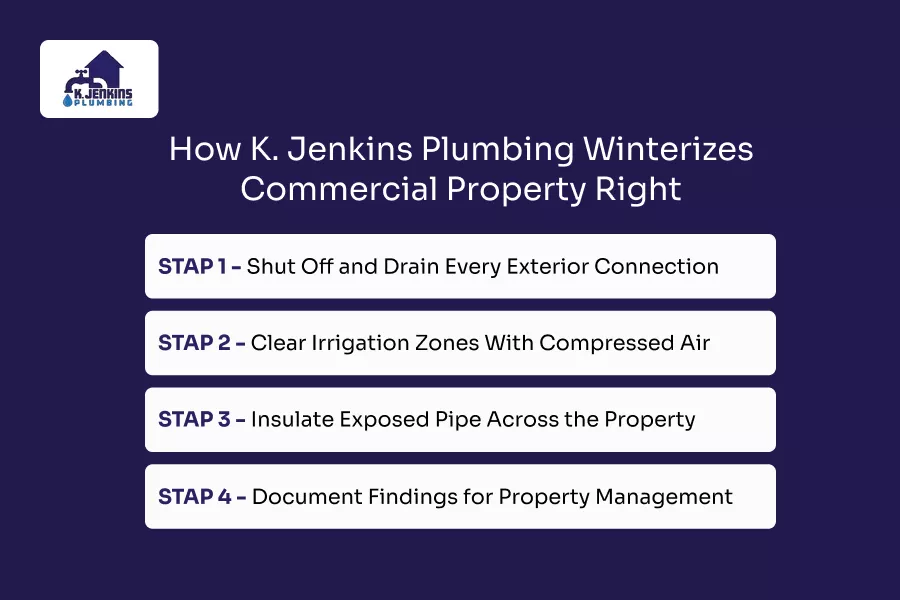
A professional winterizing visit follows the same four steps on every Virginia property, whether it is a single storefront or a large multi-building complex with several exterior lines and a full irrigation system.
Step 1: Shut Off and Drain Every Exterior Connection
A technician shuts off each exterior valve across the property and drains every connected line, addressing the full pipe section between the valve and the fixture, not just the visible connection point.
Step 2: Clear Irrigation Zones With Compressed Air
Compressed air pushes remaining water out of every irrigation zone and the backflow preventer, reaching the low points and bends across a larger commercial system that gravity drainage always leaves behind.
Step 3: Insulate Exposed Pipe Across the Property
Exposed pipe running through a mechanical room, exterior wall, or unheated utility space gets fully wrapped, addressing every exterior connection rather than just the fixtures visible from outside the building.
Step 4: Document Findings for Property Management
A technician documents each line serviced and flags any pipe section showing early wear, giving property managers a clear written record before the next hard freeze reaches the building or parking areas.
| Ready to Get Your Commercial Property Fully Winterized? Our team handles complete outdoor winterizing for offices, retail, restaurants, and multi-building properties across Winchester, Fairfax, Martinsburg, and 36-plus surrounding areas of the wider region. |
Read More About: Commercial Plumbing Maintenance Checklist for Northern Virginia Businesses
Is Your Business Ready Before the First Hard Freeze Hits?
Older commercial buildings across Winchester, Front Royal, and the Shenandoah Valley often have exterior lines original to the property, with little to no insulation protecting the pipe running through the outer wall.
West Virginia’s Eastern Panhandle sees the same freeze pattern most winters, so businesses around Martinsburg and Charles Town face identical risk to properties closer to Winchester and Fairfax, Virginia, each fall season without fail.
According to State Farm’s January 2026 newsroom data, claims filers reported more than 20,000 frozen pipe claims between 2024 and mid-2025, with total payouts topping 628 million dollars nationwide across all property types.
- Properties built before modern insulation codes see exterior line damage most often
- A full winterizing visit before the first hard freeze costs far less than an emergency closure
- Multi-building complexes benefit most from a single scheduled visit covering every exterior line
- Year-round commercial plumbing services across Winchester and Frederick County, Virginia make it easy to bundle a fall winterizing visit with routine seasonal maintenance
- Commercial property plumbing services teams in older buildings should schedule earlier, since original exterior lines rarely have modern insulation
- Home-based businesses can rely on the same residential plumbing team covering the property overall
Read More About: Warm Spot on Your Floor and Nothing Is Running? That’s Not Normal. Here’s What It Means
Conclusion
Outdoor plumbing winterizing myths cost Virginia commercial properties real money every winter, and a valve shutoff, an insulation cover, or an untouched irrigation system rarely provides the protection proactive plumbing services actually give.
K. Jenkins Plumbing provides complete commercial winterizing backed by satisfaction and workmanship guarantee. The Company offers same-day availability. Contact us before the next freeze reaches your property.
FAQs
Does Business Insurance Cover a Frozen Pipe Burst Claim?
No, standard commercial property insurance rarely covers it fully on its own. Confirming business insurance pipe damage coverage before a freeze avoids a denied claim on a burst exterior line, always.
How Do You Winterize an Irrigation System the Right Way?
A licensed technician clears every irrigation zone, valve, and the backflow device using compressed air, since gravity alone cannot remove water trapped in low points and bends underground, each fall.
What Is a Backflow Preventer and Does It Need Winterizing?
A backflow preventer stops contaminated water from flowing back into the clean supply line, and yes, it absolutely needs winterizing since standing water inside it freezes solid and cracks every year.
Can Facilities Staff Winterize Outdoor Plumbing Themselves?
Facilities maintenance plumbing staff can shut off a visible valve alone, but full winterizing needs a licensed technician for every irrigation zone and hidden interior pipe runs each fall season now.
Is Outdoor Winterizing Required by Code for Businesses?
Some Virginia localities require backflow preventer testing and freeze protection compliance under the local plumbing code, so a licensed technician should confirm exact requirements each fall season.