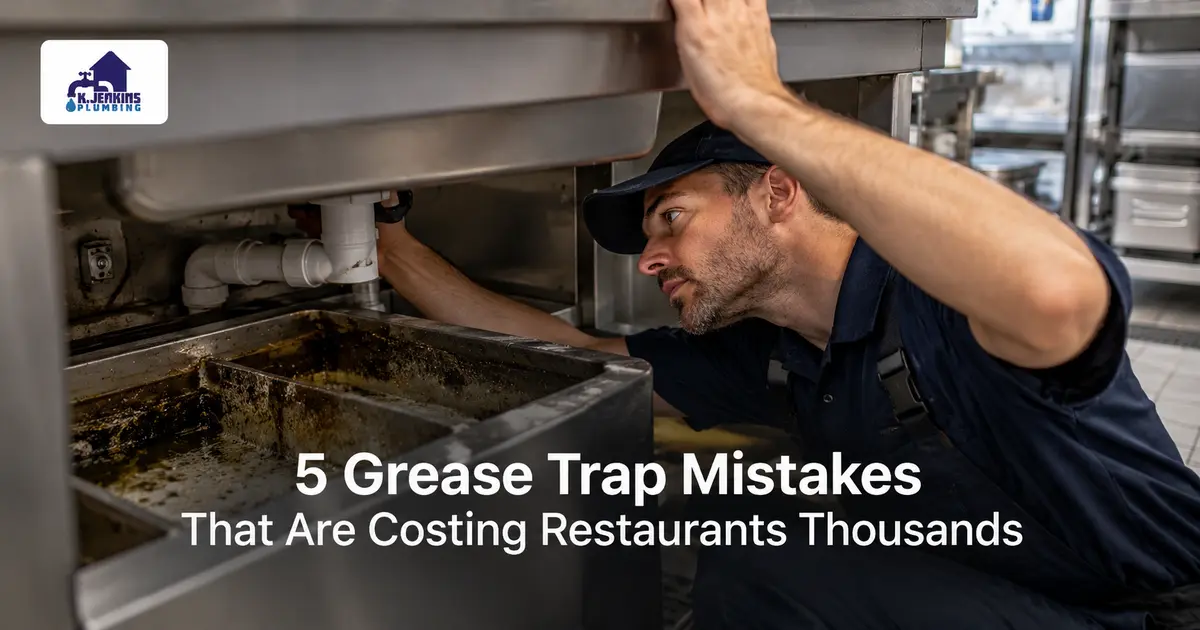
A neglected grease trap is one of the fastest ways a Winchester, Virginia restaurant loses money, whether through an emergency sewer backup, a failed health inspection, or a fine tied to fats oils and grease discharge.
Restaurant owners rarely think about the interceptor until it fails mid-shift, right in the middle of service. Here is what K. Jenkins Plumbing’s technicians see most often in commercial kitchens across the Shenandoah Valley.
Key Takeaways
- An uncleaned trap is the leading cause of emergency commercial kitchen plumbing backups
- Undersized interceptors overflow faster than kitchens expect during peak dinner service
- Virginia and West Virginia code violations can trigger real health inspection violation fines
- DIY cleaning attempts often push solids further into the line instead of removing them
- Slow drains, odors, and gurgling sounds are early signs most owners ignore
- K. Jenkins Plumbing provides grease trap pumping across 36-plus Virginia and West Virginia service areas
Why a Grease Trap Matters to Every Restaurant Kitchen Today
Restaurants need this equipment because fats, oils, and grease from daily cooking harden inside sewer lines and cause blockages, and the interceptor traps that waste before it ever reaches the shared municipal sewer system outside the building.
According to NWPX’s summary of EPA sewer overflow data, fats, oils, and grease contribute to roughly 47 percent of reported sanitary sewer overflows nationwide, making it the single leading documented cause.
A kitchen without a functioning interceptor risks violations at every health inspection, and most owners only search for grease trap cleaning services after a backup has already cost them a night of revenue and a health code write-up.
Mistake One: Why Skipping the Cleaning Schedule Backfires
The most common and most expensive mistake we see in Virginia restaurant kitchens is treating routine cleaning as optional. A unit that runs past capacity stops trapping grease and sends it straight into the sewer line.
Routine pumping is the process of removing accumulated fats, oils, grease, and solids out of the interceptor before it reaches full capacity, restoring its ability to separate waste from wastewater effectively.
Kitchens that push cleaning intervals past what the unit can handle typically discover the problem mid-shift, when the drain backs up in front of customers during the busiest hours of the entire week.
Emergency service called at that point always costs more than the routine visit would have. Already searching commercial plumbers near me in Winchester or West Virginia? Save one as a contact now to avoid the last-minute scramble.
| Is Your Unit Overdue for Cleaning? K. Jenkins Plumbing provides scheduled interceptor pumping across Winchester, Fairfax, and 36-plus surrounding Virginia and West Virginia service areas, backed by upfront pricing and a workmanship guarantee. |
Mistake Two: Installing a Unit That Is Too Small for Use
An interceptor sized for a smaller menu or lower customer count fills up faster than staff expect once a Virginia restaurant adds fryers, expands seating, or increases weekend covers without reassessing capacity.
It then forces more frequent pumping while still overflowing during the busiest shifts, exactly when a backup does the most damage. Our commercial plumbing services team can confirm whether your setup matches your kitchen’s actual output.
Read More About: Commercial Plumbing Maintenance Checklist for Northern Virginia Businesses
Mistake Three: Ignoring Virginia and West Virginia Codes
Virginia and West Virginia localities enforce interceptor rules through local sewer use ordinances, requiring documented service on a fixed, verifiable schedule with pumping records kept on file at all times.
According to the Virginia Administrative Code’s plumbing requirements, any occupancy producing grease or oil-laden waste must provide an interceptor under the International Plumbing Code that covers the state.
A documented history of missed maintenance can delay a restaurant’s health permit renewal. Searching grease trap cleaning near me in Winchester or West Virginia after hours? The problem has likely waited too long already.
Mistake Four: Attempting to Clean the Grease Trap Yourself
Kitchen staff sometimes try to scoop or hose out the interceptor between professional visits, but that usually pushes solids further down the line instead, and it can move the blockage into the municipal connection.
Commercial grease trap cleaning is professional pumping that removes fats, oils, grease, and solids entirely from the tank, rather than simply displacing the material deeper into the line.
A DIY attempt can also mask early warning signs a licensed plumber would catch, such as a cracked baffle, since a professional visit inspects the structure itself, something scooping alone always skips.
| Tried Cleaning It Yourself and Still Have Problems? Our licensed plumbers remove waste completely from the tank, not just from view, with same-day availability across Virginia and West Virginia’s entire Eastern Panhandle service region, every single week. |
Mistake Five: Ignoring the Early Warning Signs of Trouble
Most failures give warning before the actual backup happens, but kitchens under real pressure during a busy service often dismiss the early signs until the drain stops working entirely without notice.
- Slow-draining sinks near the prep area, especially after high-fat cooking shifts
- A sulfur or rotten smell near the access lid or nearby floor drains
- Gurgling sounds as water tries to pass through a narrowing line
- Grease visibly backing up into a floor drain during rinse cycles
Catching any of these signs early usually means a routine service call instead of an emergency shutdown in the middle of a busy dinner rush, a far cheaper and much calmer outcome for any restaurant owner.
How Often Should a Commercial Kitchen Clean a Grease Trap?
Most commercial kitchens need service every one to three months, though high-volume kitchens running fryers or heavy meat prep often need attention closer to every four weeks throughout the entire year.
The right interval depends on unit size, menu type, and daily customer volume, so K. Jenkins Plumbing measures actual grease accumulation at the first visit before recommending any fixed maintenance schedule.
| Kitchen Type | Typical Cleaning Interval | Why |
| High-volume fryer kitchen | Every 4 weeks | Fast grease accumulation from frying |
| Standard full-service restaurant | Every 6 to 8 weeks | Moderate, steady grease output |
| Small cafe or limited menu | Every 8 to 12 weeks | Lower daily grease volume |
The recommended practice is to measure the actual grease level at each visit and adjust the schedule based on real accumulation, rather than guessing at a fixed interval that may already be too long for your kitchen. Some busy Virginia kitchens also schedule grease pit cleaning alongside interceptor service to keep the entire waste line clear all the way to the municipal connection outside the building.
Which Grease Interceptor Type Actually Fits Your Restaurant?
Commercial kitchens generally choose between small under-sink passive gravity traps, larger outdoor or below-ground interceptors built for high-volume kitchens, and automatic grease removal units today.
Many Virginia jurisdictions specify a minimum interceptor size based on kitchen seating capacity and equipment count, so the right type often comes down to local code as much as owner preference in practice.
Our team can walk you through exactly which commercial grease trap cleaning equipment fits your kitchen and satisfies local code before any installation work ever begins on your specific restaurant site.
Read More About: 3 Commercial Plumbing Services Myths Costing You This Winter
The Real Benefits of a Well Maintained Interceptor System
A properly maintained interceptor protects a restaurant on three fronts, prevents costly backups, keeps the kitchen compliant at inspections, and protects the shared sewer system.
Restaurants with a documented maintenance history typically move through health inspections much faster, since inspectors can confirm restaurant compliance from records instead of guessing at the answer.
Structured preventive maintenance also means fewer equipment breakdowns and far fewer unplanned closures than reacting only after something fails during a busy dinner service shift at the restaurant tonight.
| Protect Your Kitchen With a Maintenance Plan K. Jenkins Plumbing builds custom maintenance plans around your kitchen’s actual grease output and daily customer volume, backed by licensed local technicians and honest, fully transparent upfront pricing. |
How to Avoid the Most Costly Grease Trap Mistakes
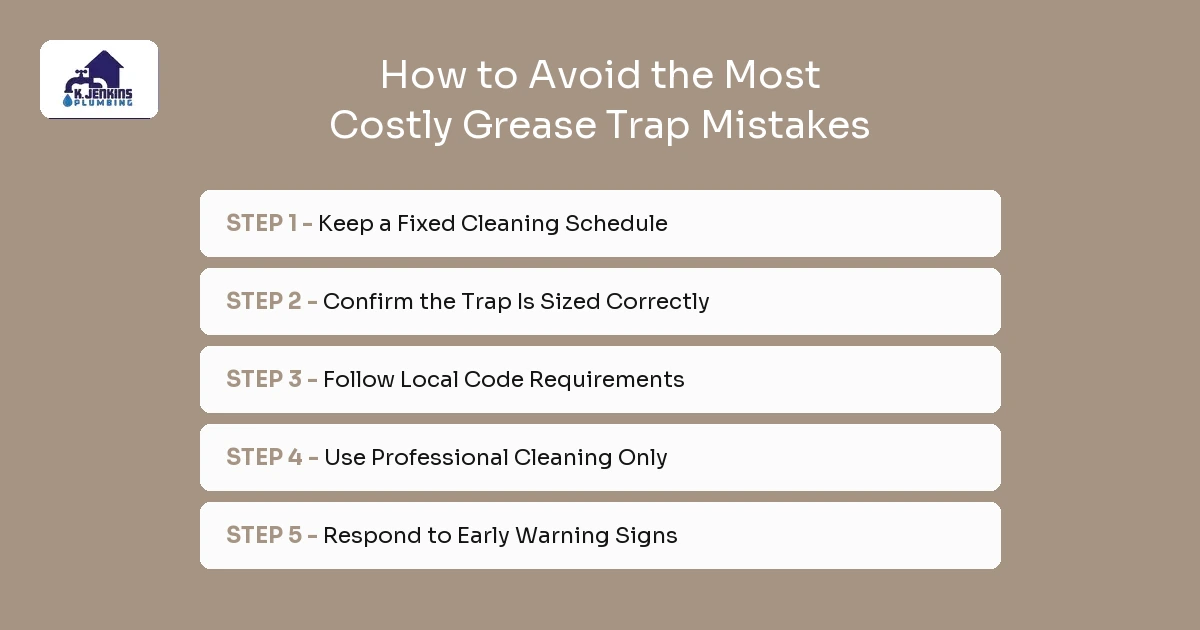
Fixing each mistake above comes down to five concrete habits. Put these on a calendar and most restaurants avoid every backup, fine, and failed inspection covered in this guide.
Step 1: Keep a Fixed Cleaning Schedule
Schedule cleaning at a fixed interval based on measured accumulation, not a guess, so the unit never gets the chance to overflow during a busy dinner rush.
Step 2: Confirm the Trap Is Sized Correctly
Have a licensed plumber confirm your interceptor size still matches your current menu, seating capacity, and daily customer volume before it falls behind.
Step 3: Follow Local Code Requirements
Maintain documented service records that satisfy your local sewer use ordinance and health department inspection standards, so an inspector finds proof, not excuses.
Step 4: Use Professional Cleaning Only
Rely on professional commercial grease trap cleaning that fully removes waste from the tank, instead of a DIY method that pushes solids deeper into the line.
Step 5: Respond to Early Warning Signs
Address slow drains, odors, or gurgling sounds near the unit immediately, before a small warning sign turns into a full kitchen backup mid-shift.
Conclusion
K. Jenkins Plumbing offers licensed grease trap service backed by upfront pricing across Virginia and West Virginia. A failure is rarely sudden, and it is almost always the result of a skipped cleaning or an ignored warning sign.
K. Jenkins Plumbing provides commercial cleaning, pumping, and maintenance plans backed by a full 100 percent workmanship guarantee on every job. Contact us today to schedule your kitchen’s next service.
FAQs
How Often Should a Grease Trap Be Cleaned and Maintained?
Most restaurants need cleaning every one to three months, depending on the menu type and daily volume, though busy fryer-heavy kitchens often need service closer to every four weeks or so.
Why Do Restaurants Actually Need to Install a Grease Trap?
This equipment captures fats, oils, and grease before they reach the sewer lines, preventing blockages and keeping restaurants compliant with local health and sewer use codes year-round.
What Rules Apply to Grease Traps in Commercial Kitchens?
Virginia and West Virginia localities require installation and documented upkeep under local sewer ordinances, and health departments verify this equipment during kitchen inspections each year.
What Are the Real Benefits of Installing a Grease Trap?
This equipment prevents emergency backups, supports smoother health inspections, protects shared sewer infrastructure, and lowers the risk of fines tied to fats and grease discharge violations.
What Types of Grease Traps Can Restaurants Choose From?
Restaurants typically choose between passive gravity traps, larger interceptors built for high-volume kitchens, or automatic units that skim grease continuously between scheduled visits.