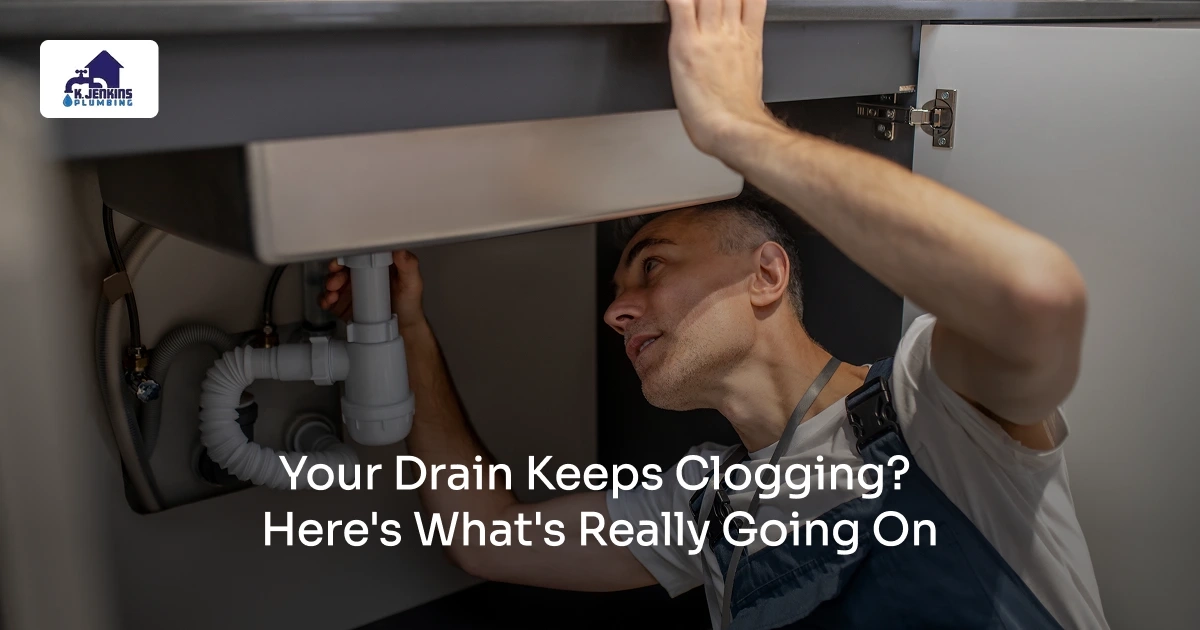
A drain that keeps clogging is telling you the blockage was never fully cleared. Surface cleaners and basic snaking punch through the clog but leave grease, scale, or buildup coating the pipe wall. The restriction rebuilds within weeks. If multiple drains are slow at once, the problem is in the main sewer line, not individual fixtures.
You poured drain cleaner down the kitchen sink two weeks ago. It drained fine for a few days. Now it’s slow again.
So you pour more cleaner. It works for a week this time. Then slow again.
This isn’t bad luck. And it’s not the drain cleaner’s fault for not working hard enough. It’s what happens when the actual problem inside the pipe hasn’t been addressed. The clog keeps coming back because something is still in there, building back up every single time.
We clear drains across Winchester, Stephens City, Berryville, Front Royal, Martinsburg, and the surrounding Northern Virginia and West Virginia region every week. And the most common thing we hear when we arrive is some version of: “I’ve been dealing with this same drain for months and nothing I try actually fixes it.”
This article explains what’s really happening inside your pipes, how to tell whether you’re dealing with a surface clog or something more serious, and when calling a plumber is the right call rather than buying another bottle of drain cleaner.
Key Takeaways
- A drain that clogs again within 2-3 weeks of cleaning has a buildup problem inside the pipe wall, not just a surface blockage.
- Multiple slow drains appearing at the same time point to a main sewer line issue, not individual fixture clogs.
- Store-bought chemical cleaners dissolve surface organic material but leave grease coating on pipe walls, so the drain slows again quickly.
- Gurgling sounds from a drain or toilet after using another fixture indicate air displacement from a partial main line blockage.
- Hydro jetting scours the full interior wall of a pipe clean rather than punching a temporary hole through a clog.
Professional drain cleaning is the process of clearing blocked or restricted drains using motorized drain snakes, hydro jetting equipment, and video inspection cameras. Unlike store-bought products that use chemicals to partially dissolve surface clogs, professional drain cleaning physically removes the blockage and clears buildup from the interior walls of the pipe. A licensed plumber can also identify what caused the clog and whether there’s a deeper issue in the main line that keeps producing the same problem.
Why Your Drain Keeps Clogging After You’ve Already Cleaned It
Here’s the thing most people don’t know about drain clogs. The visible blockage, the one that actually stops the water, is the last stage of a much longer buildup process.
Think about your kitchen drain. Every time you wash dishes, a thin film of grease coats the inside of the drain pipe. You can’t see it. The water flows fine. But every day, that film gets a little thicker. Over weeks and months, it starts collecting food particles, soap residue, and anything else that goes down the drain. Eventually the narrowing is enough to cause slow drainage.
Now you pour drain cleaner down. The chemical reaction clears the narrowest point of the restriction, enough for water to flow again. But the grease coating on the pipe walls? Still there. Still accumulating. Two weeks later you’re back to square one.
This same pattern plays out with:
- Bathroom sink drains where toothpaste, soap, and hair build up in layers just past the drain opening.
- Shower drains where hair and soap scum compact together into a dense plug that grows back quickly after partial clearing.
- Floor drains in utility rooms and garages that collect dust, sediment, and debris continuously.
The clog keeps coming back because you’re treating the symptom, not the cause. The cause is the accumulated coating inside the pipe that keeps collecting new material and rebuilding the restriction.
Why does my drain keep clogging even after cleaning?
A drain that repeatedly clogs after cleaning has a buildup problem on the interior pipe walls rather than a simple surface blockage. Standard drain cleaning methods, including chemical cleaners and basic drain snakes, clear the immediate restriction but leave the underlying coating intact. That coating collects new material and rebuilds the clog within weeks. Professional hydro jetting removes the coating from the full interior pipe wall, not just the point of restriction.
Our drain cleaning service across Winchester, Berryville, Front Royal, and the Northern Virginia region uses both motorized snaking and hydro jetting depending on what the inspection reveals inside the pipe.
| That Drain Has Been Slow for Weeks? If you’ve cleaned it twice already and it’s back to slow, the buildup is inside the pipe wall, not just the surface. Our licensed team serves Winchester and Northern Virginia with same-day availability. Call K. Jenkins Plumbing at 540-760-0341 |
One Slow Drain vs All Drains Slow: What the Difference Tells You
This distinction matters more than anything else when figuring out what you’re dealing with.
One slow drain: The problem is in that fixture’s individual drain line. It’s contained. A kitchen sink clog, a shower drain packed with hair, a bathroom sink with soap buildup. These are fixable with targeted drain cleaning and don’t necessarily indicate anything wrong with the rest of your plumbing.
Multiple slow drains at the same time: This is a completely different situation. When your kitchen sink, bathroom drain, and toilet are all sluggish simultaneously, the individual drain lines aren’t the issue. They all connect to the same main sewer line running out of your house. If that main line has a partial blockage, everything upstream of it is affected at once.
Here’s how to read the signs:
Signs pointing to an individual drain clog:
- Only one fixture is affected
- Other drains in the house are completely normal
- The problem started in that specific location first
- A drain snake or cleaning resolves it and it stays clear for weeks or months
Signs pointing to a main sewer line problem:
- Two or more drains are slow or backing up simultaneously
- Toilet gurgles when you run the washing machine or dishwasher
- Water appears in the shower or tub when you flush the toilet
- Sewage smell coming from multiple drain locations
- Drains clear briefly after cleaning but back up again within days across multiple fixtures
How do I know if my main sewer line is clogged?
The clearest sign is multiple drains backing up or running slowly at the same time. When your shower is slow, your toilet is sluggish, and your bathroom sink is draining poorly all at once, the issue is in the main sewer line where all these individual drains converge. A camera inspection is the definitive way to confirm this and identify exactly what’s causing the main line restriction.
Homes in older parts of Winchester, Berryville, and Martinsburg with mature trees on the property are particularly prone to main line issues from root infiltration, which we’ll get to shortly.
What Drain Cleaner Actually Does Inside Your Pipe
It’s worth understanding this clearly, because most people use drain cleaner expecting it to fully solve the problem and are surprised when it doesn’t.
Store-bought chemical drain cleaners work through one of two mechanisms. Alkaline cleaners, usually lye-based, generate heat and saponify grease while dissolving hair and organic material. Acidic cleaners, typically sulfuric acid-based, work faster but are more corrosive. Both produce a chemical reaction at the point where the concentration of cleaner is highest, which is usually the surface of the clog directly below the drain opening.
What this means practically:
The cleaner dissolves enough of the immediate blockage to restore flow. But it rarely travels far enough down the pipe to address buildup in the longer pipe run. And it does essentially nothing to the grease coating on the pipe walls, which is the underlying cause of the recurring problem.
The pipe damage issue:
This is the part most people don’t consider. Older homes across Martinsburg, Charles Town, and Winchester built before 1980 often have PVC drain lines with rubber-sealed joints. Repeated use of chemical drain cleaners degrades these seals over time, accelerating joint failure and potentially creating new leak points in a system that was otherwise intact. Cast iron drain lines, common in homes built before the 1960s, experience accelerated internal corrosion with repeated chemical exposure.
So the cycle of repeated drain cleaner use doesn’t just fail to solve the problem. It can gradually make the pipe itself less reliable.
Also Worth Knowing: If your home uses a septic system rather than a municipal sewer connection, chemical drain cleaners disrupt the bacterial balance in the tank that breaks down waste. Our residential plumbing team can advise on drain approaches for homes in rural parts of Frederick County, Warren County, and Clarke County that rely on septic systems.
What Happens When a Plumber Cleans Your Drain vs What You Do at Home
The difference isn’t just about tools. It’s about what actually happens inside the pipe.
What you do at home:
Standard bottle of drain cleaner: chemical reaction at the surface of the clog, partial dissolution, temporary clearance. Basic hand-operated drain snake from a hardware store: mechanical cable fed into the drain that hooks and pulls out surface debris or punches a hole through a soft clog. Result: drain flows better for a few days to a few weeks, then slows again.
What a licensed plumber does:
Motorized drain snake (auger): A professional-grade motorized cable with a cutting head that rotates at high speed. It cuts through compacted hair and debris, breaks up solid clogs, and reaches much further into the pipe than a hand snake. More effective for standard clogs, particularly in bathroom drains.
Hydro jetting: High-pressure water is directed through a specialized nozzle that sprays in multiple directions simultaneously. The forward jet breaks up blockages. The backward-facing jets scour the interior walls of the pipe, removing the grease coating, mineral scale, and soap buildup that standard cleaning leaves behind. The result is a pipe that’s clean from wall to wall, not just temporarily cleared at the point of restriction.
Video drain inspection: A small waterproof camera feeds into the drain line and transmits live footage to a screen. This shows the plumber exactly what’s inside the pipe before and after cleaning. Root infiltration, offset pipe joints, pipe scale, collapsed sections, and grease accumulation are all visible directly. The guesswork is removed entirely.
How often should drains be professionally cleaned?
For most homes in Northern Virginia, professional drain cleaning every 1-2 years as preventive maintenance keeps lines clear and identifies developing issues before they cause backups. Homes with multiple occupants, older cast iron drain lines, or drains that see heavy grease use may benefit from annual service. For commercial kitchens in Winchester and the surrounding area, quarterly drain cleaning is the standard recommendation.
| Want This Handled For You? Our licensed plumbing team handles professional drain cleaning for homes and businesses across Winchester, Stephens City, Front Royal, Berryville, Martinsburg, and surrounding areas. Contact Us Online Or Call 540-760-0341 |
If Your Drains Are Slow Everywhere at Once, Stop Using Drain Cleaner
When multiple drains are slow simultaneously, pouring more chemical cleaner into individual fixtures is not going to fix the problem. Here’s why, and what actually needs to happen.
Your home’s individual drain lines all converge into a single main sewer line that runs underground from the house to either the municipal sewer system or your septic tank. When that main line develops a restriction, every fixture upstream is affected because the water has nowhere to go fast enough.
What causes main sewer line problems:
Tree root infiltration. The most common cause in older residential areas across Winchester, Berryville, Front Royal, and Martinsburg. Tree roots actively seek moisture and grow toward the small amounts of water vapor that escape from pipe joints. Once a root finds a joint crack, it gradually expands the opening and enters the pipe. Inside the pipe, root growth traps waste and progressively reduces the pipe’s carrying capacity. This is an invisible process until the line becomes significantly restricted.
Grease accumulation over years. Years of kitchen grease going down the drain builds up in the main sewer line where individual drain lines connect. Unlike a fixture drain that can be snaked directly, main line grease accumulation requires hydro jetting to clear effectively.
Pipe scale in older cast iron lines. Homes built before the 1960s in parts of Winchester and Martinsburg often have cast iron main sewer lines. These develop internal scale buildup over decades that progressively narrows the pipe bore.
Pipe offset or partial collapse. Soil movement, tree roots, and general aging can cause sections of the underground sewer line to shift out of alignment or partially collapse. Water still flows but waste accumulates at the offset point.
A camera inspection of the main sewer line is the only definitive way to know which of these is causing the problem and what repair approach is needed.
Read More: Why Is My Water Bill So High? Leak Detection Can Save Your Virginia Home
Can tree roots really get into my drain pipes?
Yes, and it’s more common in Northern Virginia than most homeowners expect. Tree roots seek moisture and grow toward the water vapor escaping from pipe joints underground. Once a root enters a joint, it expands the crack and grows inside the pipe, trapping waste and progressively blocking flow. Homes in older neighborhoods across Winchester, Berryville, and Martinsburg with mature trees near the sewer line path are at elevated risk, particularly with clay pipe or older iron sewer lines.
| Drains Backing Up in Multiple Rooms? That’s a main line issue. Our licensed team uses camera inspection to find the exact cause before recommending any repair approach. Same-day service available across Northern Virginia and West Virginia. Schedule a Main Line Inspection or Call 540-760-0341 |
Running a Business in Northern Virginia? Your Drains Need a Different Schedule
Commercial drain lines handle dramatically higher daily usage than residential systems. A restaurant in Winchester or a busy office building in Leesburg puts through volumes of water, grease, food waste, and soap that a residential home never sees. The buildup rate is proportionally higher and the consequences of a backup are far more serious.
A backed-up kitchen drain during a restaurant dinner service doesn’t just create a plumbing problem. It’s an operational shutdown, a potential health code violation, and a loss of revenue for every hour the kitchen can’t run. A blocked restroom facility in a retail or office building creates similar disruption.
Recommended drain cleaning schedule for Northern Virginia commercial properties:
- Restaurants and commercial kitchens: Quarterly at minimum, monthly for high-volume operations
- Office buildings: Annual professional cleaning with monthly staff-level visual checks
- Retail and hospitality: Bi-annual professional cleaning
- Industrial facilities: Assessment-based, depending on specific operational output
Our commercial plumbing maintenance services include scheduled drain care programs for businesses across Northern Virginia and West Virginia. For food service operations, we combine drain cleaning with grease trap management to address the full pipeline from kitchen fixture to main line.
Read More : Commercial Plumbing Maintenance Checklist for Northern Virginia Businesses
Conclusion
A drain that keeps coming back slow is not a plumbing mystery. It’s buildup on the pipe wall that surface cleaning never fully removes. The pattern repeats until the pipe interior is actually cleaned, not just temporarily cleared.
One slow drain in one room is usually an individual fixture issue. Multiple slow drains appearing together point to the main sewer line. Gurgling sounds and sewage smells confirm it.
Our team at K. Jenkins Plumbing clears drains and inspects sewer lines across Winchester, Stephens City, Front Royal, Berryville, Strasburg, Martinsburg, Charles Town, and the surrounding Northern Virginia and West Virginia region. We carry 96+ five-star Google reviews because we find the actual cause and fix it properly rather than offering a temporary solution.
Call us at 540-760-0341, check out our residential plumbing services, or contact us online to schedule same-day drain cleaning or a main line camera inspection.
Warm Spot on Your Floor With Nothing Running? Read This
Recurring drain backups and unexplained water loss sometimes trace back to a pipe leaking beneath the foundation rather than inside the drain lines. If your water bill keeps climbing and drains keep backing up with no clear cause above ground, a slab leak may be the reason nobody found yet.
FAQs
Why does my drain keep clogging even after I clean it?
A drain that clogs again within weeks of cleaning has buildup on the interior pipe walls, not just a surface blockage. Chemical cleaners and basic snaking clear the immediate restriction but leave the underlying grease or scale coating intact. That coating collects new material and rebuilds the clog quickly. Professional hydro jetting removes the coating from the full pipe wall rather than punching a temporary hole through the restriction.
How do I know if my main sewer line is clogged?
The clearest sign is multiple drains backing up or running slowly at the same time. If your shower is slow, your toilet is sluggish, and your bathroom sink is draining poorly simultaneously, the issue is in the main sewer line, not individual fixture drains. Gurgling sounds from the toilet when you use the washing machine and sewage smells from multiple drain locations are additional main line indicators.
Does K. Jenkins Plumbing offer drain cleaning in Winchester and Northern Virginia?
Yes. We provide professional drain cleaning for residential and commercial clients across Winchester, Stephens City, Front Royal, Berryville, Strasburg, Martinsburg, Charles Town, and the surrounding Northern Virginia and West Virginia region. Same-day service is available. Call 540-760-0341 to schedule.
Can tree roots really get into my drain pipes in Northern Virginia?
Yes, and it’s more common than most homeowners expect. Tree roots grow toward moisture escaping from underground pipe joints. Once a root enters a joint crack, it expands the opening and grows inside the pipe, trapping waste and progressively restricting flow. Homes in older neighborhoods across Winchester, Berryville, and Martinsburg with mature trees near the sewer line are particularly susceptible.
How often should drains be professionally cleaned in a Virginia home?
For most residential homes in Northern Virginia, professional drain cleaning every 1-2 years as preventive maintenance keeps lines clear and catches developing issues before they cause backups. Homes with multiple occupants, older cast iron drain lines, or heavy grease usage may benefit from annual service. Commercial kitchens in Winchester and the surrounding area generally need quarterly professional drain cleaning.
What is hydro jetting and is it safe for my pipes?
Hydro jetting uses high-pressure water directed through a specialized nozzle to scour the interior walls of drain pipes clean, removing grease coating, mineral scale, and root material. It is safe for properly installed PVC and cast iron drain lines in good structural condition. A licensed plumber inspects the pipe with a camera first to confirm the pipe can handle the pressure before hydro jetting begins.
How quickly can K. Jenkins Plumbing respond to a drain backup in Northern Virginia?
We offer same-day response for drain cleaning and drain emergencies across Winchester, Stephens City, Berryville, Front Royal, Martinsburg, and surrounding areas. For active sewage backups, we prioritize rapid dispatch. Call 540-760-0341 for immediate assistance.
Is chemical drain cleaner bad for my pipes?
Repeated use of chemical drain cleaners can degrade PVC pipe joint seals over time and accelerate internal corrosion in older cast iron drain lines. For homes with septic systems, chemical cleaners can also disrupt the bacterial balance in the tank. For a one-off slow drain that responds immediately, occasional use is generally low risk. For recurring clogs that need repeated treatment, professional cleaning is a more effective and less damaging long-term approach.